What Dhruv Srinivasan works on —
and why his result is clever
A five-minute read, no physics background needed. Dhruv is a quantum-computing researcher whose standout result made a hard simulation run twice as far on today's noisy hardware — by shrinking the circuit, not by waiting for better machines. Here's the idea, in pictures.
Who he is
| Now | PhD student at MIT (Electrical Engineering & Computer Science), in the Quantum Coherent Electronics group — building better superconducting qubits and the microwave links that connect quantum machines together. |
| Before | Dual degrees in Physics and Mechanical Engineering at the University of Maryland, doing research on light-based ("photonic") quantum devices and trapped-ion quantum computers. Two summers at IBM Quantum. |
| The through-line | He makes quantum hardware do more with what exists today — squeezing real performance out of imperfect machines instead of waiting for perfect ones. |
The problem: quantum computers run out of room
Suppose you want to simulate how a crowd of electrons behaves inside a material — the kind of question that decides whether something is a magnet, a superconductor, or nothing special. This is famously hard for normal computers, and it's one of the things quantum computers are supposed to be good at.
The catch: a quantum computer simulates time in tiny slices (physicists call them Trotter steps), and every slice costs a stack of delicate operations called two-qubit gates. Each gate adds a little noise. Do too many, and noise swamps the answer — the machine hits a wall. So the number of gates you spend per slice literally decides how far into the future you can simulate before the result turns to mush.
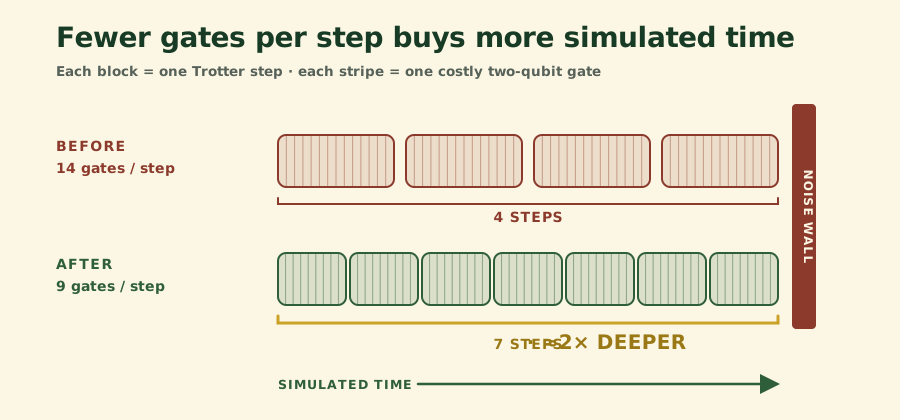
Each block is one time-slice; the stripes inside are the costly two-qubit gates. Cheaper slices mean more of them fit before the noise wall — so you see further into the simulation.
What he did: shrink the circuit, keep the physics
Dhruv's work (a trapped-ion collaboration run on IonQ's quantum computer) attacks the gate bill directly. Three ideas stack together:
- Rewrite the problem so mistakes are catchable. He recasts the electron model as something called a lattice gauge theory, which comes with built-in symmetries — extra rules the true answer must obey. Any run that breaks a rule is obviously corrupted, so it can be thrown out.
- Retune every gate with a smart optimizer (IPG). The same computation can be written many ways; a well-chosen set of gate settings does the identical job with fewer gates. His optimizer finds those settings reliably, even when the search is bumpy.
- Delete the gates that don't earn their keep (entropy compression). He measures how much each gate actually contributes to the entanglement the simulation needs — and drops the ones adding essentially nothing.
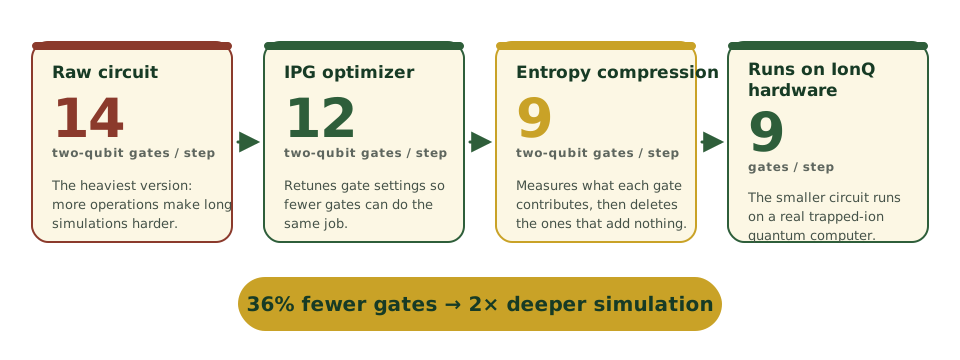
The gate bill per time-slice drops from 14 to 9 — and the shrunken circuit still reproduces the original to about one part in ten thousand, checked on a normal computer.
Why it's a nice result
Most of the excitement in quantum computing is about someday building bigger, cleaner machines. Dhruv's result is a reminder that a lot of headroom is hiding in the software: with a sharper way to write the same circuit, a machine you already have reaches problems it couldn't touch yesterday. Doubling how far a simulation can run, on real hardware, without adding a single qubit — that's the kind of practical win that moves the field along while the big machines are still being built.
A small experiment: we pointed a research system at this result
Full disclosure — this page is written by Ohara Labs, and we couldn't resist a test. We handed our autonomous research system the compression strategy from Dhruv's paper and asked it to carry the optimization out and, crucially, to certify the result with a sealed, independent checker it cannot see or influence. No human tuned the final circuit; no quantum hardware was involved.
It worked. The sealed checker confirmed a circuit at Dhruv's gate count that matches the ideal time-slice to about one part in ten trillion. The system then pushed to go lower — and this is the interesting part: one attempt dropped a gate, and the checker immediately flagged it as cheating. The shortcut had quietly wrecked the physics (the circuit stopped matching the target), so it was rejected, not accepted.
The rest of his work
- Light that behaves quantum-mechanically. A Nature Physics paper (2024) on steering light through a tiny ring-shaped device in a way that mimics exotic "topological" materials — plus follow-on work making special "squeezed" light for ultra-precise measurement.
- Keeping lasers locked. A control-systems trick that holds a delicate optical device steady using higher-order feedback — the sort of engineering that keeps quantum experiments from drifting.
- Now: superconducting qubits at MIT. His current PhD work is on a different quantum hardware platform and on wiring separate quantum processors together — the plumbing of a future quantum network.